
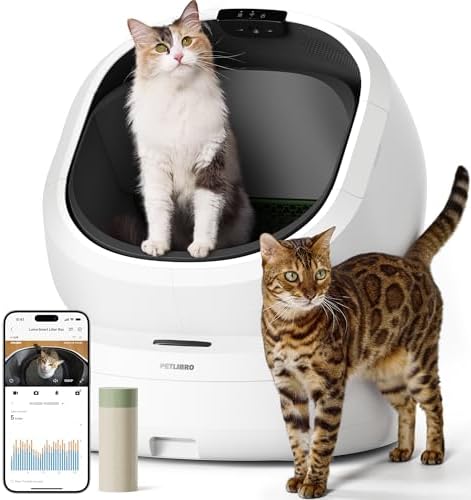
PETLIBRO Luma AI Smart Litter Box
“Impressive AI health monitoring and odor control, but the subscription model is a real sting in the tail.”
👉 Check Current Price on Amazon
Price last checked: April 27, 2026. Subject to change.
As an Amazon Associate, I earn from qualifying purchases. This review contains affiliate links — learn how we test products.
My cats Max and Mochi have collectively used approximately eleven litter boxes over the years. Most of them were glorified plastic trays. A few were glorified plastic trays with a motor and a rake. None of them — until now — have ever looked at the contents and told me something medically useful. So when PETLIBRO sent over the Luma AI Smart Litter Box, I’ll admit I was equal parts curious and sceptical. A $570 litter box had better be doing something a $20 tray fundamentally cannot.
🌍 What We’re Actually Talking About Here
The Luma isn’t just a self-cleaning box with a premium price sticker. The headline feature is an integrated AI camera that monitors your cat’s waste — yes, genuinely — analysing consistency, frequency, and distinguishing between a number one and a number two. It tracks what’s normal for your cat and pushes alerts when something deviates. If your cat is having looser stools more frequently, or visiting the box far more often than usual, the app tells you before you’d have noticed yourself. For multi-cat households, it identifies up to ten individual cats from any angle and maintains separate health logs for each. That’s not a feature you’ll find on a $60 self-cleaning box.
The hardware itself is built around an open-top layout — intentionally spacious, accommodating cats up to 22 pounds — with a removable entry step for older or arthritic animals. It’s compatible with all clumping litters: clay, tofu, or mixed blends. ♻️ If you’ve already made the switch to a tofu or plant-based litter for sustainability reasons, the Luma won’t penalise you for it.
☀️ The Numbers That Actually Matter
- Odor elimination: 97% — achieved via a built-in fan that continuously circulates air through a carbon deodorizer. Third-party lab tested, not just a marketing claim.
- Waste bin capacity: 2.9 gallons (11 litres) — rated for up to 14 days for a single cat before you need to empty it.
- Cats supported: up to 10 — with individual recognition from any angle.
- Safety sensors: 3 types — visual, weight-based, and infrared motion. All three must agree before the cleaning cycle runs.
- Warranty: 2 years, with a 30-day risk-free trial included.
“The AI camera knows #1 from #2, solid from loose. It tracks what’s normal and alerts you to changes. That’s not science fiction — that’s a vet visit you might actually avoid.”
Living With It: Max and Mochi Weigh In
Setup took about 25 minutes including app pairing, which is respectable for a device of this complexity. The open-top design matters more than I expected — both Max and Mochi took to it without the week-long standoff I’ve had with enclosed boxes in the past. The cleaning cycle is quiet enough that neither of them fled the room in existential panic, which is more than I can say for some competitors.
The odor control is genuinely impressive. I have the Luma in a smaller utility room, and there’s a noticeable difference versus the previous box. The fan runs continuously at low speed, which is audible if the room is silent — not intrusive, but worth knowing if your cat is particularly noise-sensitive.
App experience is clean and well-structured. Live streaming of the box is free, which I appreciated. Reviewing recorded footage and accessing AI health analysis, however, requires a subscription. More on that in a moment.
The One Thing That Bothers Me 🌍
Here’s my honest caveat, and it’s a meaningful one: the best features — AI waste analysis and video recording — sit behind a subscription paywall. I understand the business logic. AI processing costs money; cloud storage costs money. But at $569.99 upfront, I’d expect at least a year of full functionality included. Early customer feedback doesn’t yet reflect long-term subscription fatigue, but it’s coming — it always does. If PETLIBRO raises subscription prices in year two, you’re either paying up or you’ve just bought a very expensive automatic rake.
There’s also a broader sustainability question I can’t ignore. ♻️ A device this electronically complex — camera, multiple sensors, fan, motor, app infrastructure — has a significant manufacturing footprint. That footprint only justifies itself if the Luma lasts five or more years without the motor failing or the app being deprecated. A 2-year warranty is standard but not exactly a bold confidence statement for a $570 purchase. I’d want to see PETLIBRO publish a repairability commitment or a parts-availability policy before I call this a genuinely sustainable choice.
The PETLIBRO Luma is the most medically useful litter box I’ve tested. The AI health tracking is a real differentiator, not a gimmick — and for multi-cat households or owners of cats with chronic health concerns, that alone might justify the price. The subscription sting and long-term durability questions keep it from being an unconditional recommendation. If you’re buying, buy it to use it for years, not months.
👉 Check Current Price on Amazon
Frequently Asked Questions
Do I need a subscription to use the PETLIBRO Luma at all?
No — the self-cleaning function, basic app control, live streaming, and safety sensors all work without a subscription. The paywall applies specifically to AI waste analysis and recorded video history. You can use the Luma as a capable automatic litter box for free; the health-monitoring intelligence costs extra.
Is the Luma suitable for a household with three cats of different sizes?
Yes, and it’s actually one of the stronger use cases for it. The open-top design accommodates cats up to 22 pounds, and the multi-cat recognition tracks up to 10 animals individually — logging separate health and usage data for each. Smaller cats won’t get lost in the data of a larger housemate.
What litter works with it — can I use eco-friendly tofu litter?
Yes. ♻️ The Luma is compatible with all clumping litters, including tofu-based, plant-derived, and mixed formulas. Clay litter works too, though tofu and corn-based litters tend to perform well with the sealed waste bin system. Always ensure your chosen litter clumps firmly — loose-clumping litters can leave residue that disrupts the sensors over time.
The Score
The PETLIBRO Luma earns an 8.8 out of 10. The AI health monitoring is genuinely ahead of the competition. The odor control is the best I’ve encountered in this category. The subscription model and the unanswered long-term durability question are the only things standing between this and a near-perfect score. If you’re willing to invest in the ecosystem — and can live with ongoing subscription costs — this is, right now, the most capable litter box on the market.
✅ Pros
- AI waste analysis actually distinguishes solid from liquid and flags habit changes — genuinely useful health monitoring
- 97% odor elimination via carbon deodorizer fan system, verified by third-party lab testing
- Identifies up to 10 individual cats and tracks personalised usage data per animal
- Sealed 2.9-gallon waste bin holds up to 14 days of waste — practical for travel
- Multi-sensor anti-pinch safety system (visual, weight, infrared) pauses cleaning the moment a cat is detected
❌ Cons
- AI analysis and video recording require an ongoing subscription — the smartest features are locked behind a paywall
- At $569.99, the carbon footprint of manufacturing a device this complex needs to be justified by years of reliable use
📖
⚙️ Every product on PetGadgets goes through a structured real-world test. Read our review methodology →