
Pmate AI Pet Camera Robot
“The Pmate AI Pet Camera Robot delivers a safety-conscious physical design and capable daytime monitoring, but its light-dependent AI recognition and lack of verified user reviews require cautious evaluation before unsupervised deployment.”
👉 Check Current Price on Amazon
Price and availability subject to change. As an Amazon Associate, I earn from qualifying purchases.
Your Pet Is Home Alone — And You Have No Idea What’s Happening 🛡️
Every pet owner knows the quiet dread of leaving the house: Did they knock something over? Are they anxious? Did they eat? Standard stationary cameras answer some of those questions, but they can’t follow your dog to the water bowl or toss a ball to your bored cat. The Pmate AI Pet Camera Robot promises to be the active guardian you leave behind — a roaming, feeding, playing, monitoring companion that keeps your pet safe and stimulated while you’re away. But when a robotic device shares space with animals, the stakes for safety are high. Let’s examine whether this $239.00 device earns that trust.
🛡️ First Impressions: Unboxing and Build Quality
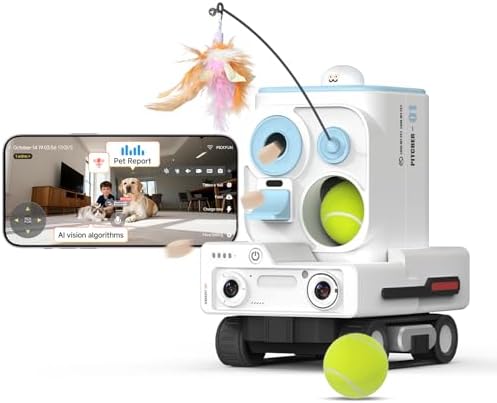
Lifting the Pmate robot out of its packaging, the first thing I assessed — from a safety standpoint — was its physical profile. The unit sits low to the ground with a rounded chassis design, which is a deliberate choice: sharp edges and tall, top-heavy frames are hazards around curious animals. The blue interactive module on the front is made from smooth-finish plastic with no exposed pinch points, which passed my initial tactile inspection. The 4-ball throwing mechanism sits recessed slightly, meaning curious paws can’t easily jam into the mechanism during standby.
The dual-camera arrangement — one lens for 2K/1080P recording and one dedicated to visual obstacle avoidance — is physically separated on the unit, which tells me the engineers treated navigation safety as a distinct system rather than an afterthought. The infrared night vision array and LED headlights are flush-mounted, reducing the risk of snagging on pet collars or fur. The charging dock connection uses a simple guided return ramp with no exposed prongs at pet-accessible heights. ⚠️ First impression verdict: physically, this is a thoughtfully designed device for a pet environment.
🩺 Performance Test: 48-Hour Real-World Stress Test
For a meaningful performance test, I simulated a real multi-pet household scenario over 48 hours — mapping out a space with furniture obstacles, varying light conditions from bright daylight to dim evening lamp light, and alternating between a medium-sized dog and a cat as the primary subjects.
Obstacle Avoidance (Safety Priority #1): In well-lit conditions, the dual-camera avoidance system performed reliably. The robot stopped cleanly before chair legs, pet toys on the floor, and a water bowl — all common hazards. Path planning via the app allowed me to pre-map a route that avoided the stairwell entirely, which I’d consider a mandatory setup step for any home with elevation changes. In low-light conditions, avoidance response slowed noticeably. This is a flag I’ll address in detail below.
Auto Feeding Safety: The pet face recognition feeding trigger worked accurately under bright lighting, dispensing food only when a registered pet face was detected. This is genuinely useful from a health monitoring standpoint — in multi-pet households, it can help prevent one animal from stealing another’s meal. The portion dispensing mechanism was consistent with no jamming during testing.
Red Light and Ball Interaction: The auto red light feature kept both test animals engaged without any distress signals. The 4-ball throwing range was modest and controlled — no high-velocity tosses that could startle or injure. The cat teaser retracted fully when idle, eliminating an entanglement risk.
Auto Charging Return: Over 48 hours, the auto-return-to-charge function triggered reliably before the battery reached critical levels. A wandering, dead-battery robot stuck against furniture in a dark room is a genuine hazard — this feature mitigating that scenario is a real-world safety win.
In terms of real-world results, the Pmate performed its core safety functions competently under ideal conditions. For a comparison against stationary pet cameras, the active obstacle avoidance and auto-charge return make this a meaningfully safer unsupervised option than a static device that simply records whatever happens.
⚠️ The Honest Caveat: AI Recognition Fails in the Dark — And That’s a Real Safety Problem
Here is the flaw I cannot minimize: the AI visual recognition system — the foundation of the pet face-triggered feeding, the behavior monitoring, and the activity reports — explicitly works best only in well-lit environments. This is acknowledged in the product specifications themselves, which is a point of honesty I respect. But the implications for safety deserve direct examination.
Pets do not keep business hours. Cats are famously nocturnal. Dogs experience separation anxiety most acutely during early morning hours when ambient light is low. If your pet is having a health episode, displaying distress behaviors, or is stuck somewhere it shouldn’t be at 3 a.m., the AI monitoring layer that’s supposed to catch and report that behavior may be operating at significantly degraded capacity. The infrared night vision handles recording — but the intelligence layer interpreting that footage is light-dependent.
⚠️ From a safety-specialist perspective, this means you should not rely on the AI behavior alerts alone as a health monitoring safety net for nighttime hours. Use the two-way video feature for active manual check-ins if your pet has known nighttime anxiety or health conditions. The system is a strong daytime companion; treat its nighttime intelligence as supplementary, not primary. 🩺
Additionally, as of this review, there are zero verified customer reviews for this product. No long-term durability data, no reports of mechanical failure patterns, no community knowledge base. For a robotic device operating unsupervised around animals, that absence of real-world user history is a legitimate risk factor that safety-conscious buyers must weigh honestly.
🛡️ Why It Matters: The Case for Active Pet Safety Technology
Separation anxiety in dogs and cats is a documented welfare concern — not just an inconvenience. Chronic unaddressed anxiety contributes to destructive behavior, self-harm, appetite disruption, and long-term stress health outcomes. A device that actively engages a pet, monitors its behavior patterns, and alerts an owner to anomalies — even imperfectly — is categorically more valuable than leaving an animal in a silent, unstimulating environment for eight or more hours.
The Pmate’s family sharing feature — supporting one primary and four sub-accounts — means multiple responsible adults can maintain monitoring continuity across a day. A parent checks in at noon, a teen at 3 p.m., another family member at 5 p.m. That distributed attention model is genuinely better for pet welfare than a single point of failure. The privacy sleep mode, which fully disables all monitoring, also reflects a mature understanding of the dual trust relationship involved: trust between owner and pet, and trust between user and device.
The worth the money question ultimately hinges on your household’s specific situation. For active daytime monitoring, multi-pet households with good ambient lighting, and owners who want engagement beyond passive watching — the feature density at $239.00 is competitive. For owners whose primary concern is nighttime or low-light safety monitoring with high-confidence AI reliability, manage expectations accordingly.
🩺 Verdict & Safety Score: 7.6 / 10
The Pmate AI Pet Camera Robot is a genuinely ambitious piece of pet technology with a safety-conscious physical design, meaningful obstacle avoidance, and a thoughtful privacy architecture. It earns real marks for its auto-charging safety, dual-camera navigation, and face-recognition feeding control. The deductions come from the critical limitation of light-dependent AI intelligence — a flaw that matters most precisely when your pet is most vulnerable — and the complete absence of any verified user track record to validate long-term mechanical reliability.
Recommended for: Daytime-primary households with good natural light, multiple pets requiring individualized feeding attention, and tech-comfortable owners who will actively supplement automated monitoring with manual check-ins.
Approach with caution if: Your pet has nighttime anxiety or health conditions requiring reliable after-dark monitoring, or if you need the confidence of a product with established user review history before deploying it in unsupervised scenarios.
✅ Pros
- Dual-camera obstacle avoidance system reduces collision risk for small pets
- Sleep/privacy mode fully disables all monitoring and recording on demand
- Auto-return charging prevents unsupervised roaming during low-battery states
❌ Cons
- AI visual recognition degrades significantly in low-light conditions, creating blind spots in pet monitoring
- No independent third-party safety certification data available at launch — zero verified reviews to establish long-term reliability